
Assistive Tech and Deafblind Independence
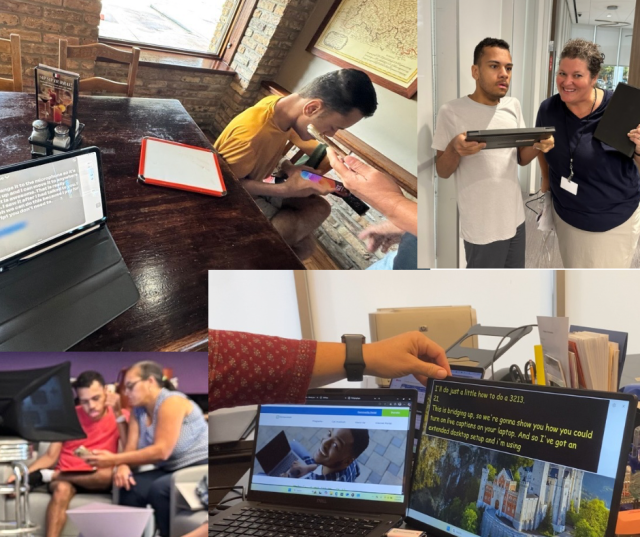 Christopher Harvey is a 19-year-old BridgingApps client with deafblindness (co-occurring hearing and vision disabilities) and autism. Christopher’s mother, Jennifer Bailey, shared the following story.
Christopher’s vision disabilities affect his circadian rhythm, so I’m frequently up with him at night. I use some of that time to surf the internet for programs that might help him.
One night while I was scrolling Facebook, a training from Easter Seals/BridgingApps popped up in my feed. I clicked through to learn more—and that’s how we discovered Easter Seals Greater Houston and the trainings they offer. BridgingApps turned out to be exactly what our family needed.
Opening Up a Larger World
My favorite programs are the digital-skills and technology-training classes. Christopher has learned to use the computer more confidently; to understand internet safety and his digital footprint; and to explore new ways of learning and socializing. The program really opened up his world and showed us what’s possible. It’s not just about gadgets. It’s about dignity, connection, and having real options for the future.
Christopher loves his iPhone and computer. These tools have transformed how he participates in school, appointments, and everyday life.
The biggest milestone was discovering live captions on our devices. Turning spoken language into text, which Christopher could follow, opened up a whole new level of access for him. Now, instead of just sitting there during a conversation or meeting, he’s starting to advocate for himself in ways he couldn’t before.
“I met Christopher when he enrolled in our Comcast-funded digital literacy program. He was my first client with deafblindness and autism, and I felt both overwhelmed and excited. I didn’t know sign language, which was his primary communication method at the time, but I realized that live captions could change how he accessed spoken information. Suddenly, there was a new way for Christopher to follow along and participate.” –Tara Rocha, BridgingApps Digital Learning Specialist
New Ways of Talking
When it comes to spoken language, sometimes Christopher is unintelligible to new acquaintances. Making the screen [text-to-speech] his voice brings more people into his communication circle.
He also has a love of music, which he uses to connect with others. He will find a song on the computer and invite you to come along with him, to join in.
So overall, Christopher uses his iPhone, computer, music, videos, typing, and captioning as a multimodal system to show what he wants, feels, and enjoys—pulling communication partners into his digital world so they can understand him.
Tech Notes
- On the computer, an enlarged monitor/dual-screen setup with headphones has made it much easier for Christopher to engage. With the enlarged screen and captions, he can read and work online in ways that weren’t possible before.
- BridgingApps classes have taught him about online safety, different computer programs, and how to connect with others.
- When out in the community, he uses his phone to videotape our travel routes. Then he likes to go on the computer and look for people who posted similar routes.
- One time there was an outage and we were cut off from digital communications. Fortunately, Christopher had already taken the initiative to record some of the videos he loved. He remembered that everything was there, and he was a happy camper.
- Another time, my own iPhone went haywire and crashed. Even the Apple Store couldn’t figure out how to fix it, so I bought a new one. I gave the old phone to Christopher—mostly because he liked its case—and he played with it and, somehow, got it working again.
- All this builds his confidence; and it really shows us how much he can learn with technology, which makes it easy to encourage him to learn more.
- For our family, technology has shifted daily life from constant workaround and worry to confidence and hope. Instead of us constantly translating the world for Christopher, technology is finally helping him access it himself.
Christopher will graduate from high school this year, and then start an 18+ transition program where he can explore a whole bunch of options to thrive and keep learning.
Endnote: Deafblindness and Society
I wish that more people understood how isolating deafblindness can be. With that dual sensory loss, it takes extra effort to understand one’s environment and to reach through the confusion. A person living with deafblindness needs others to plan, adapt, and be patient in making information truly accessible.
Deafblindness is primarily about access, and access includes intentional learning and intentional conversation. If we had more support around deafblindness, much loneliness would be removed and there would be more happy moments.
-Katherine Swarts, BridgingApps, Easter Seals Greater Houston